
Case studies
The engine where it has to hold up
Where THIRI has done real work outside a chat window, written the way we work: what was built, what was measured, with the method and the data linked, and what is still open. More studies follow as the people in them sign off.
VSL 1:00
CC
Captions & transcript (9 lines)
- 0:00 Most music AI lives in a chat window.
- 0:02 This is the THIRI engine where it has to hold up.
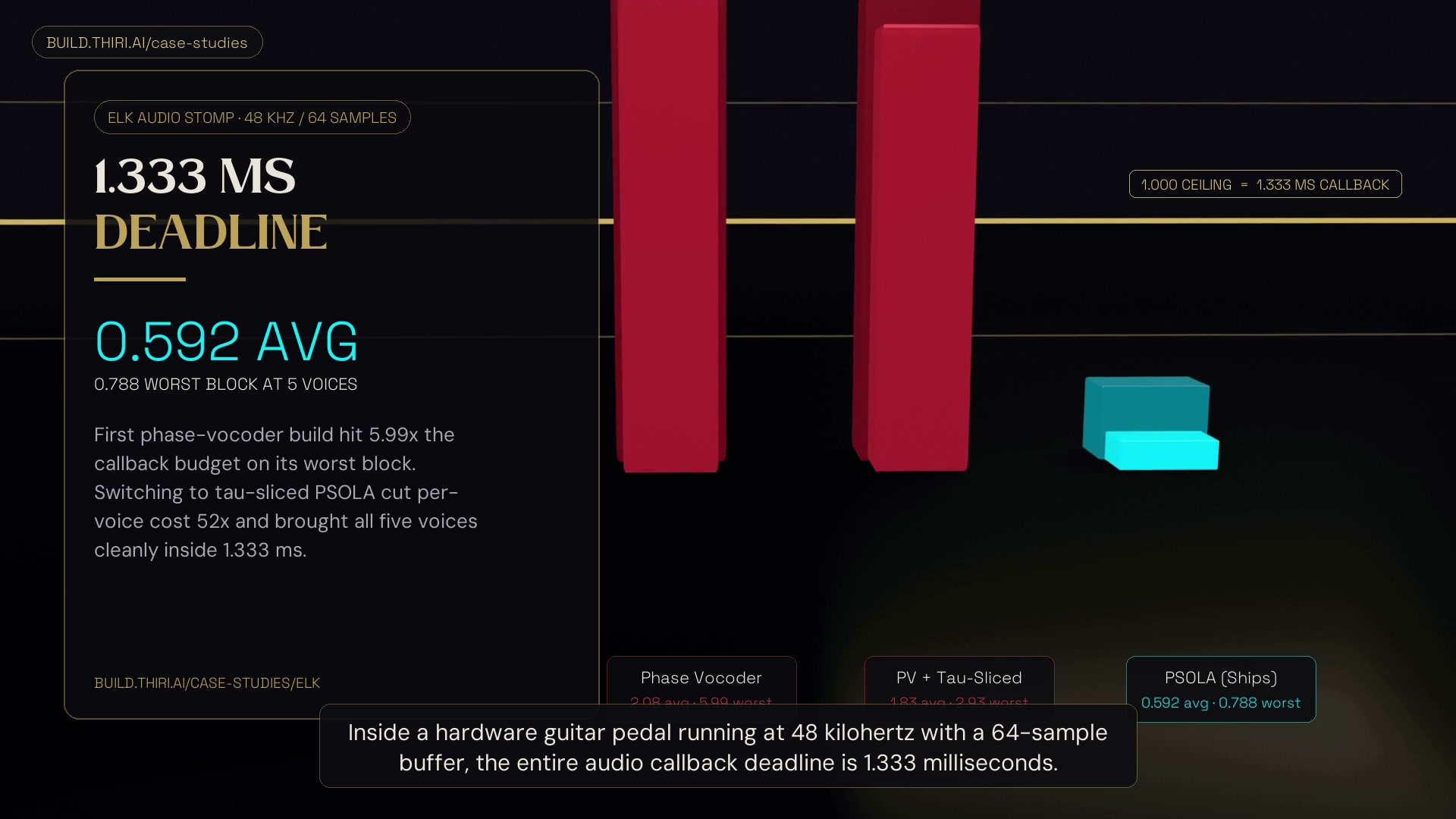
- 0:05 Inside a hardware guitar pedal running at 48 kilohertz with a 64-sample buffer, the entire audio callback deadline is 1.333 milliseconds.
- 0:16 Miss one block and the stage hears a glitch.
- 0:20 On the Elk Audio Stomp dual-core ARM chip, THIRI's C++ core runs deterministic chord voicing plus five formant-preserving PSOLA harmony voices inside that deadline.
- 0:32 Five voices average 0.592 of the callback, with a 0.788 worst block and half a percent marginal cost per voice, pinned by 16,353 golden vectors.
- 0:43 First place in the Montreal Elk Audio challenge, with method and raw data linked below.
- 0:50 If your build has a real-time constraint like that, book 20 minutes on this page.
- 0:55 Or grab a free key and build on the engine yourself.
Working with us
The pedal work started as a conversation about a constraint: a deadline in microseconds. If you have one of those, book 20 minutes. If you want to build on the engine yourself, get a key and start with the quickstart.